Game Histories (2025)
Why and how Atari’s first video game PONG established an industry that shapes consumers’ relationships to technology to this day.PONG is one of the longest- and most consistently circulating video games. Released in 1972, it remains at our fingertips as Android or iOS app, hosted at freepong.org and the Internet Archive, and even released as A Tiny Game of Pong for the Apple Watch. Despite its simplicity and ubiquity, Atari’s PONG encapsulates far more than the history of a video game and an iconic game company. King PONG is the first book dedicated to an unassuming game that changed the world. Through the prisms of product positioning, market development, and category creation, Raiford Guins answers the question of why Atari’s inaugural product succeeded and why it endures.The author of Game After and Atari Design, and an excavator of the “Atari landfill” in New Mexico, Guins brings us a unique history that reconsiders the launch of Atari’s PONG through the lens of the company’s business practices. He follows the young Silicon Valley startup from its early days of positioning its new product within the existing coin-op amusement industry to its establishment of a consumer industry for home video games—a story of remarkable market development innovation. Written with a passion for video games and a historian’s insight, the book animates the business exploits of one of the fastest growing and most influential companies ever.
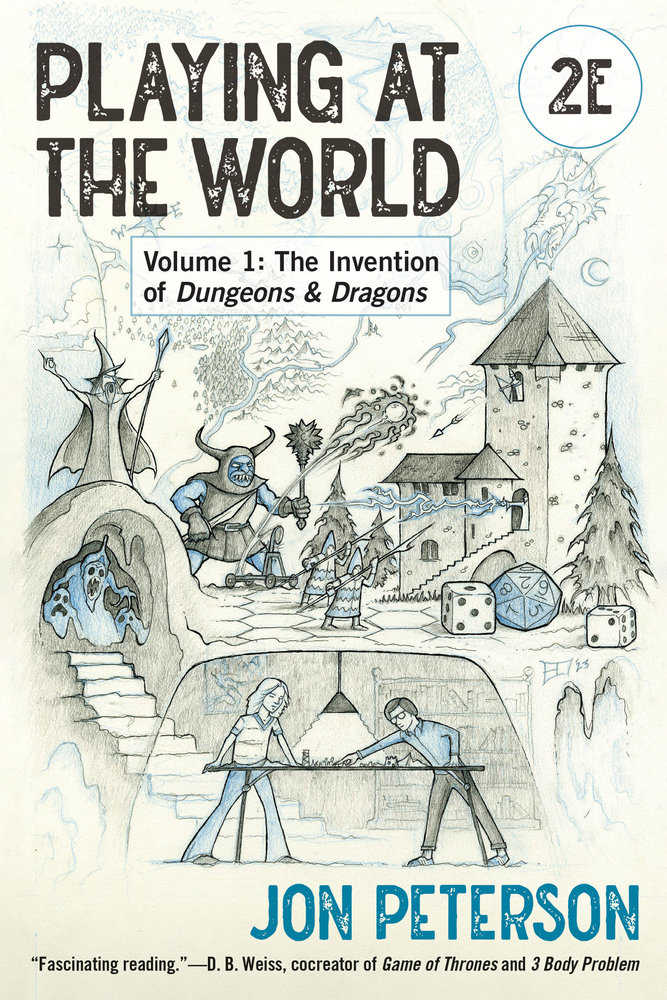
The first volume of two in a new, updated edition of the 2012 book Playing at the World, which charts the vast and complex history of role-playing games.This new edition of Playing at the World is the first of two volumes that update the 720-page original tome of the same name from 2012. This first volume is The Invention of Dungeons & Dragons, which explores the publication of that iconic game. (The second volume is The Three Pillars of Role-Playing Games, a deeper dive into the history of the setting, system, and character of D & D.) In this first volume, Jon Peterson distills the story of how the wargaming clubs and fanzines circulating around the upper Midwest in the 1970s culminated in Gary Gygax and Dave Arneson’s seminal role-playing game, D & D. It augments the research of the original editions with new insights into the crucial period in 1972–3 when D & D began to take shape.Drawing from primary sources ranging from eighteenth-century strategists to modern hobbyists, Playing at the World explores the origins of wargames and roleplaying through the history of conflict simulations and the eccentric characters who drove the creation of a signature cultural innovation in the late twentieth century. Filled with unparalleled archival research (from obscure fanzines to letters, drafts, and other ephemera), this new edition of Playing at the World is the ultimate geek’s guide to the original RPG. As such, it is an indispensable resource for academics and game fans exploring the origins of the hobby.
Series Subscriptions — Coming Soon
Subscribe to get new issues automatically added to your pull list.
Writer
Jon PetersonAll Issues
Reading Order
-
Playing At The World, 2 E, Volume 1
The first volume of two in a new, updated edition of the 2012 book Playing at the World, which charts the vast and complex history of role-playing games.This new edition of Playing at the World is the first of two volumes that update the 720-page original tome of the same name from 2012. This first volume is The Invention of Dungeons & Dragons, which explores the publication of that iconic game. (The second volume is The Three Pillars of Role-Playing Games, a deeper dive into the history of the setting, system, and character of D & D.) In this first volume, Jon Peterson distills the story of how the wargaming clubs and fanzines circulating around the upper Midwest in the 1970s culminated in Gary Gygax and Dave Arneson’s seminal role-playing game, D & D. It augments the research of the original editions with new insights into the crucial period in 1972–3 when D & D began to take shape.Drawing from primary sources ranging from eighteenth-century strategists to modern hobbyists, Playing at the World explores the origins of wargames and roleplaying through the history of conflict simulations and the eccentric characters who drove the creation of a signature cultural innovation in the late twentieth century. Filled with unparalleled archival research (from obscure fanzines to letters, drafts, and other ephemera), this new edition of Playing at the World is the ultimate geek’s guide to the original RPG. As such, it is an indispensable resource for academics and game fans exploring the origins of the hobby.